The cool morning and warm afternoon made it a pleasant day out on the lake for field crews of the UC Davis Tahoe Environmental Research Center on Tuesday.
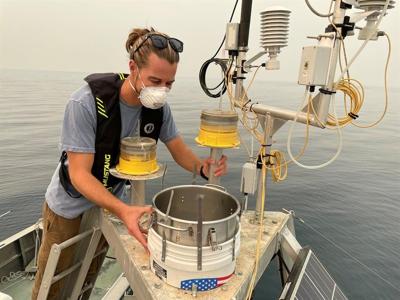
Brant Allen, the research center's Field Lab Director and Staff Research Associate, Brandon Berry, took a boat out on the waters of Lake Tahoe to collect samples, measurements and data. The Tahoe Environmental Research Center keeps track of their findings to monitor Lake Tahoe's clarity and ecosystem.
Allen established a long-term career at the research center. In his 30 years of work there, he said he has noticed a decline in the water's clarity. It hasn't been dropping as low in the past ten years, but he said it's still important to track the progress to find solutions to revitalize the lake.
Allen's team uses different tools to collect data. They could measure clarity by lowering a white disc down into the lake. The clarity is determined by the disc's visibility. Allen said because of wildfire smoke, the clarity of the lake is below normal for this time of year, which could lead to negative outcomes.
"When the smoke comes over the lake there's a lot of ash fallout. There's a lot of particulate matter that gets into the water." Allen said. "The ash specifically has a lot of nutrients associated with it, nitrogen and phosphorus. The same thing you put on your lawn to make your lawn grow. That makes the algae in the lake grow as well. So we can get algal grow in the lake that would not be typical this time of year because of the smoke impacts."
According to the Center for Disease Control and Prevention (CDC), harmful algal blooms cam make a person sick and be deadly for animals.
A lot of the smoke in the Lake Tahoe Basin is coming from the Caldor Fire, which first sparked on August 14 and has been active for 37 days as of September 21. Firefighters are making progress on the fire's containment, but it has already burned more than 220,000 acres of land and destroyed over 1,000 buildings and homes. Aside from the immediate devastation, Allen said Lake Tahoe could discover more of the fire's impacts even after it is extinguished.
"The longer-term effects could be by erosion," he said. "We have to worry about how the burned forest actually is able to erode sediment into the lake."
As for the lake's clarity, Allen said the it should improve over time.
"Typically the fires we've seen before, they haven't been as intense or as close as the Caldor Fire, but the lake clarity rebounds pretty quickly, in a matter of months." He added, "If you were a tourist coming out to Lake Tahoe you'll still be amazed by its clarity and the blueness of that water, but there is a measurable decline that we have seen."
Other methods used to collect samples and data include four floating buoys that hold Atmospheric Deposition Buckets on top of the mechanism. Atmospheric Deposition Buckets are replaced hold clean water and is replaced at least once a week. The water mimics the surface of the lake and collects particles and nutrients that fall, like ash that has been coming from raging wildfires.
With more research and data scientists like Allen hope to learn more about how wildfires will affect Lake Tahoe in the long run.
Allen said, "Our overall goal of Lake Tahoe is, one, obviously to assess the changes on Lake Tahoe to advise management agencies on what the best practices might be to restoring the lake and maintaining it's amazing clarity."