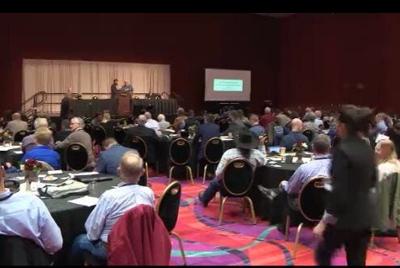
Standing outside the packed Tuscany Ballroom at the Peppermill, Eureka County Commission Chair J.J Goicoechea tells us, "There's no 2 sides in there. This is a win-win."
Inside, delegates are from all Western range states, representing groups like the Humane Society of the U.S. and the U.S. Forest Service. There are Utah State and UNR professors, and conservation groups like The Wildlife Society. Delegates from these organizations seemed to share a positive mood. Equid Summit facilitator and horse owner Dan Adams told me, "The time is now to come and find ways to work together. There's consensus about that. So that's what's exciting, to have all those people in the same room together."
Galloping through the Western mountains and plains, wild horses are a symbol of freedom. But with the BLM rounding up thousands every year, our wild horses are anything but free. The roundups are dangerous, leaving some horses injured or dead. Or they might be adopted and illegally sold for slaughter. Adoption isn't working. 50,000 mustangs are now in holding pens awaiting new owners, but the number of people taking one home is at an all-time low. Goicoechea tells me, "It's hard to place horses. Horses are expensive to have and maintain. Society has kind of shifted away from that." Yet their population grows, he says "20 percent annually across the board. So exponentially, that means we double every 4 to 5 years."
So what can be done? There are 88,000 wild horses in America right now, and the BLM says the land can only sustain 27,000. The status quo, leaving things the way they are, won't work…no matter what side you're on. Goicoechea says, "They are a symbol of the West. Nobody hates horses, we all love the horses. But it's to the point now where they are negatively impacting their own health, because we have so many in some areas." San Stiver, formerly with the Nevada Department of Wildlife, now with the Western Association of Fish and Wildlife Agencies adds, "This is an environmental issue, and if you want a reasonable environment out there, you need to look at active management."
There is no solution at the summit yet. Goicoechea says that may be impossible, unless a higher power makes a decision. As he puts it, "Congress really needs to make the move. They have created this. They are the ones that hold the purse strings."
But so far at the summit, its nothing more than talking and listening…and hoping for some give and take. Adams told me, "It isn't the end. This isn't the one and only summit to solve it all. I really see this, as a start."
Meanwhile, the BLM is taking a unique approach, paying you $1,000 if you adopt and care for a mustang over its lifetime. To qualify, adopters must have enough space for a horse, and no history of animal abuse.
We have a link to the program in the online story below:
https://www.blm.gov/programs/wild-horse-and-burro/adoptions-and-sales/adoption-incentive-program